Blog

  • “Trusted Financial Advisor” Versus “Latest AI Tools”: Why “Trusted” Is Not Always About “Human vs. Machine”

    “Trusted Financial Advisor” Versus “Latest AI Tools”: Why “Trusted” Is Not Always About “Human vs. Machine”

     When considering the “trusted financial advisor” option, one is usually pitted against “latest AI tools.” However, what really differentiates these options for most of us is whether we want continuous human involvement, accountability, and guidance or whether we prefer our investments managed automatically without having anyone to hold accountable.

    The value of being recommended by a trusted friend

     When a friend recommends a financial advisor, it’s a good sign that the advisor has done a great job for their family. This means the advisor has probably been good at keeping in touch and coming up with a solid plan that works even when the market gets tough.

    A good financial advisor can create a plan that’s just right for you, taking into account when you want to retire, how taxes will affect your investments, and how much risk you’re willing to take. This personalized approach is really important because investing is not just about making money, it’s also about understanding how you make financial decisions and helping you stick to your goals. By considering your individual priorities and preferences, a financial advisor can help you develop a strategy that works for you and gives you the best chance of achieving your long-term financial objectives.

    When it comes to finding a financial advisor, it’s crucial to know how they share their approach and if they’re registered, even if they work online. The Financial Industry Regulatory Authority, or FINRA, suggests starting your search by asking friends and colleagues for recommendations and then asking potential advisors some key questions. You can find more information on this on the FINRA website.

    Advantages of using a trusted financial advisor

    Lets start with the importance of getting personalized advice and detailed planning. A human advisor will be able to design a plan based on all aspects of your financial state, not just your answers to questions. You should also consider that your advisor can offer behavioral coaching in case of market declines.

    Market declines can lead to rash decisions due to the investor’s fear and confusion. Behavioral finance research provides empirical evidence for investors’ emotional and irrational behavior during challenging times. ( Kato, 2021; MDPI, 2024). ( papers.ssrn.com)

    Coordination with other financial professionals

    You might need to get advice from other experts, like tax specialists or estate planners, to help you reach your goals. Or, your employer might have some special benefits that can help. An advisor can guide you through all this and make sure you’re getting the best help possible. They can connect you with the right people and make the process easier for you.

     Accountability and continuity of advice

     It’s not just a matter of responding to what’s happening in the news, you’ll have someone who can help you make informed decisions about your investments and break down the pros and cons.

    Disadvantages of using a trusted advisor

    1. One of the downsides of getting advisory services is that they can be expensive, and sometimes this cost isn’t really needed for simpler situations.
    2. Quality may be inconsistent. While “recommended by a friend” is a good sign, it does not guarantee the highest quality of the service; always check credentials and compensation structure.
    3.  Possible conflicts of interest – According to FINRA, there may be conflicts of interests that arise due to particular fee structures or the advisor’s incentives. ( FINRA, n.d.-b). ( finra.org)

    When AI tools come to the rescue

    AI tools are really useful when it comes to creating and managing investment portfolios automatically. They make it easy to balance your investments and keep track of everything. The SEC, which is like a watchdog for investments, says that robo-advisors are a type of online platform that helps investors by collecting information and creating portfolios based on that. This is according to some reports from 2017, which you can find on the SEC’s website, investor.gov. These robo-advisors are pretty handy, and they’re becoming more popular because they’re convenient and can help people make smart investment decisions.

    Advantages of AI investment tools

    1. Automation and convenience It’s really easy to keep an eye on and adjust your investments, so you can make sure they’re doing what you want them to.
    2. Lower barriers to entry. The simplicity of getting started with AI tools is making it more appealing to investors who were previously hesitant, and now they’re more likely to take the plunge and start investing.
    3. Rule-based decision making may lead to consistency.

    Disadvantages of AI investment tools

    1. Absence of context and absence of human judgment
    2. Because many websites use information from surveys to give advice, AI tools might not consider the complexities of your personal situation when offering guidance.
    3. Suitability of advice must be checked
    4. According to SEC, it is important for investors to understand the logic behind automated advice, risk tolerance management techniques, and research the service provider on platforms such as IAPD. ( SEC, 2017a; SEC, 2017b). ( investor.gov)

    Potential issues with the quality of services.

    According to the SEC’s Division of Examinations, there were several issues observed with respect to advisers providing electronic investment advice. The issues included disclosure problems and improper portfolio management practices. ( SEC, 2021). ( sec.gov)

     A practical approach to choosing advice

     If your goal is to combine AI tools with a trusted advisor, a common solution is to use AI tools for automation and educating yourself. Turn to your trusted advisor in case of more difficult tasks: tax management, complex planning, retirement strategies, and, most importantly, behavioral coaching in case you wish to deviate from your portfolio.

    Ultimately, regardless of whether you decide to use AI tools, consult a trusted advisor, or opt for a combination of both, it’s crucial that you conduct thorough research on the provider’s credentials and understand what motivates them.


    References (APA)

    FINRA. (n.d.-a). Working with an investment professional. FINRA. (finra.org)

    FINRA. (n.d.-b). Conflicts of interest. FINRA. (finra.org)

    Kato, S. (2021). Staying strong during the market storm: Pre-crash interventions to reduce panic selling (SSRN Scholarly Paper No. 4230281). Social Science Research Network. (papers.ssrn.com)

    MDPI. (2024). Emotional instability and financial decisions: How neuroticism fuels panic selling. Behavioral Sciences, 12(12). (mdpi.com)

    U.S. Securities and Exchange Commission. (2017a). Investor bulletin: Robo-advisers (Investor.gov). (investor.gov)

    U.S. Securities and Exchange Commission. (2017b). SEC staff issues guidance update and investor bulletin on robo-advisers (Press release). (sec.gov)

    U.S. Securities and Exchange Commission. (2021). Observations from examinations of advisers that provide electronic investment advice (Risk Alert). (sec.gov)

    ____________________________________________
    Learn more:

    1. Staying Strong During the Market Storm: Pre-Crash Interventions to Reduce Panic Selling by Seiya Kato :: SSRN
    2. Conflicts of Interest | FINRA.org
    3. Investor Bulletin: Robo-Advisers | Investor.gov
    4. SEC.gov | Observations From Examinations of Advisers That Provide Electronic Investment Advice
    5. Emotional Instability and Financial Decisions: How Neuroticism Fuels Panic Selling
    6. SEC.gov | SEC Staff Issues Guidance Update and Investor Bulletin on Robo-Advisers

  • The Next Frontier: How Tech Is Transforming Marketing Communications in 2026

    The Next Frontier: How Tech Is Transforming Marketing Communications in 2026

    In 2026, the landscape of marketing communications is no longer defined merely by digital channels or flashy creative—technology now dictates strategy, engagement, and competitive advantage.

    The past few years have been marked by rapid innovation, but this moment feels different. We have moved from using technology for marketing to letting technology drive marketing in deeply strategic, measurable, and dynamic ways.

    AI: From Tool to Strategic Partner

    Artificial intelligence is no longer the buzzword experiment it once was. According to recent industry research, AI adoption among marketing teams has reached near-ubiquity, with 91 % of organizations using AI in some capacity and a growing focus on scaling AI workflows beyond early experimentation. However, governance and quality have emerged as the most significant barriers to operationalizing AI at scale.

    This signals a shift: AI is maturing from a tactical assistant—writing copy or scoring leads—to a strategic co-pilot embedded deeply in decision cycles. Leaders such as EY’s Chief Digital Officer describe an inflection point where AI enhances segmentation, targeting, and creative insight in ways humans alone simply cannot match.

    Emerging academic work suggests even more ambitious horizons. Frameworks like MindFuse propose generative AI systems that reason about campaign strategy, interpret performance signals, and adapt messaging in real time—making AI a creative and strategic partner, not just a production engine.

    Hyper-Personalization and Predictive Experiences

    Personalization has long been a goal for marketers—but now it is evolving into predictive personalization. Innovative platforms can anticipate what buyers need before they explicitly express it, tailoring content, offers, and journeys. These capabilities go well beyond inserting a name in an email; they leverage patterns in behavior, intent signals, and propensity models to orchestrate experiences that feel individually crafted.

    At the same time, privacy changes and the deprecation of third-party cookies have accelerated investment in privacy-first personalization using first- and zero-party data. Marketers are unifying data lakes and deploying CDPs (customer data platforms) to preserve relevance while maintaining customer trust.

    Omnichannel and Immersive Tech

    While AI powers personalization behind the scenes, extended reality (XR), AR, and VR are reshaping customer engagement in more tactile ways. From virtual try-ons to immersive brand experiences, these technologies bridge digital and physical realities, creating memorable interactions that elevate communication beyond one-way messaging.

    Similarly, omnichannel orchestration platforms now ensure that customers receive a unified message whether they are interacting via email, social media, SMS, web, or even in-app. This omnipresence is no longer optional; it is expected.

    Data, Analytics, and Automation at Scale

    Underpinning all this innovation is data—the raw fuel that powers AI, analytics, and customer understanding. Modern marketing communication stacks emphasize real-time analytics, automated campaign workflows, and predictive attribution models that help teams pivot quickly and optimize live performance.

    In effect, strategy has become a feedback loop: data ➝ insight ➝ decision ➝ action ➝ learning. This is not just optimization; it is adaptive marketing—growing smarter with every interaction.


    In conclusion, the latest tech advancements in marketing communications are not incremental improvements, they represent a change in basic assumptions. AI has moved from automation to augmentation, personalization has become predictive, and immersive experiences are redefining how brands communicate. For forward-thinking professionals, the opportunity lies not just in adopting these technologies, but in integrating them into strategy, creativity, and organizational culture. The brands that win in 2026 will be those that harness these innovations not just to execute campaigns, but to reinvent how they connect with people.

    ____________________________________________________________________
    Research Sources:

    Comtex News:New Jasper Research Shows AI Is Now Core to Marketing, With Scale and Governance Emerging as Top Barriers – COMTEX News

    January 27, 2026 : Business Insider / EY’s chief digital officer says marketing is at an AI ‘inflection point’

    arXiv: MindFuse: Towards GenAI Explainability in Marketing Strategy Co-Creation

    Siddhi Infosoft: Sales Technology Trends 2026: Top 10 Innovations Shaping Sales

    Comtex News

    Marketing Technology (MarTech) Market Worth USD 3.28 Trillion by 2035 Driven by AI, Agile Marketing, and Privacy-First Personalization – COMTEX News

    Top 9 Marketing Technology Trends & Innovations in 2025July 16, 2025 — Companies leverage AI, extended reality (XR), Web3, the metaverse, big data, and analytics. Social commerce and omnichannel

  • Why Sales and Marketing Should Never Share a Job Title

    Why Sales and Marketing Should Never Share a Job Title

    At first glance, combining sales and marketing into one role seems like a smart way to stretch your budget. After all, both departments aim to drive growth, right? But here’s the problem: what looks like efficiency on paper often translates to inefficiency in practice. When one person is tasked with both closing deals and building awareness, the result is watered-down performance, missed opportunities, and ROI that never reaches its full potential.


    📖 The Sales-Marketing Split: A Case for Specialization

    Sales and marketing are two engines powering the same vehicle—but they function very differently.

    Marketing is about the long game. It’s strategic, analytical, and focused on building brand awareness, generating leads, and nurturing prospects. Sales, on the other hand, is about momentum. It’s reactive, interpersonal, and laser-focused on conversion and revenue.

    When companies assign both responsibilities to one person—often under the vague title of “Sales/Marketing Manager”—they risk creating a jack-of-all-trades who masters none. That individual is forced to split time between optimizing ad campaigns and chasing quarterly quotas. The result? Neither side performs to its potential.

    Companies don’t save money this way—they just underperform in two critical areas. Marketing campaigns go underutilized, and sales pipelines remain inconsistent. Worse, it becomes difficult to measure what’s actually working.

    By contrast, companies that invest in specialized leadership for both sales and marketing experience sharper focus, clearer accountability, and significantly higher returns.


    📊 Interactive Chart: Comparing Performance Outcomes

    Here’s a data visualization that compares key performance metrics between companies that hire a single Sales/Marketing Manager and those that hire specialized managers for each function.*
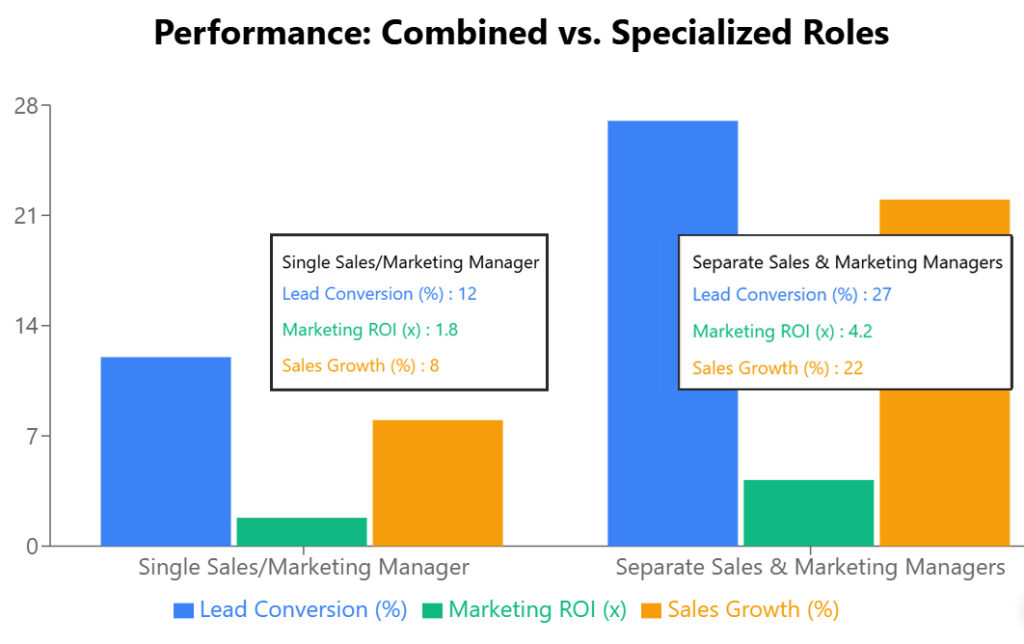
    Performance on job titles
    Performance Combined versus Specialized

    ✅ Final Thoughts: Invest Where It Matters

    The idea that “one person can do both” might make sense when you’re a startup with three employees—but as your business grows, so should your leadership structure. Dividing sales and marketing into distinct, specialized roles isn’t just a structural change; it’s a strategic upgrade.

    The data is clear: focused leadership delivers focused results. Don’t dilute your growth strategy. Invest in dedicated experts—and watch both your pipeline and your brand thrive.

    *Sources used to generate comparison chart:
    📚 Key Industry Sources Used for Modeling

    1. HubSpot – State of Inbound Report
      https://www.hubspot.com/state-of-inbound
    2. Salesforce – State of Sales
      https://www.salesforce.com/resources/research-reports/state-of-sales/
    3. Content Marketing Institute – B2B Benchmarks
      https://contentmarketinginstitute.com/research/

    Set up a meeting!

  • “The Color That Isn’t There: Why Magenta Is a Beautiful Lie”

    “The Color That Isn’t There: Why Magenta Is a Beautiful Lie”

    Stepping into my fine art shoes for something completely different.

    Have you ever wondered why magenta doesn’t appear in the rainbow? It’s not because you missed it. It’s because it’s not really there—at least, not in the way colors like red or green are. Magenta is what scientists call a non-spectral color, which means it doesn’t have a wavelength of light associated with it. In fact, magenta isn’t a color that exists in the physical spectrum of light at all. It’s something your brain makes up.

    Let’s break that down.


    The Science of Seeing Color

    To understand why magenta doesn’t exist in the real world, we need to take a quick dive into how humans perceive color. Our eyes contain cells called cones that detect different ranges of light: red, green, and blue. These cones send signals to the brain, which then interprets combinations of them as colors.

    For example:

    • When red cones are stimulated, you see red.
    • When green and red cones are stimulated together, you see yellow.
    • When all three are stimulated, you see white.

    Now here’s where it gets interesting.


    The Color Spectrum Has Limits

    Visible light is made up of a continuous spectrum of wavelengths ranging from about 380 nanometers (violet) to 750 nanometers (red). Every color on the spectrum corresponds to a specific wavelength. Blue has a short wavelength, red has a long one, and green is somewhere in between.

    But notice something missing? There’s no magenta.

    If you look at a rainbow or a spectrum created by a prism, you’ll see red, orange, yellow, green, blue, indigo, and violet. Nowhere in there is magenta. Why? Because there’s no single wavelength of light that corresponds to magenta. It isn’t part of the spectrum. It’s not a real color in the physical sense.


    Magenta: A Brain-Born Illusion

    So what happens when your eyes are exposed to both red and blue light—but no green? There’s no wavelength in between red and blue (they’re on opposite ends of the visible spectrum), so your brain is in a bit of a bind.

    Instead of panicking, your brain does something clever: it invents a new color.

    Rather than showing you both red and blue at the same time, or leaving a confusing gap, your brain constructs a color that doesn’t actually exist in the outside world. That color is magenta.

    In technical terms, magenta is an extra-spectral color—a color the brain synthesizes from the simultaneous stimulation of red and blue cones, with very little or no green cone stimulation. It’s the mind’s way of resolving a paradox. Your brain essentially says, “I don’t know what this is, so here’s something that feels right.”


    Why This Matters

    Understanding magenta helps reveal a deeper truth about color itself: color is not a property of light alone—it’s a product of perception. The world doesn’t come pre-colored. Your brain is actively interpreting sensory data and making educated guesses.

    Magenta is a perfect example of this mental magic trick. It’s not “out there” in the world like red or blue light—it’s “in here,” inside your head, a beautifully convincing illusion.


    So Is Magenta Real?

    It depends on how you define “real.” Magenta might not exist as a wavelength of light, but it’s certainly real in your experience. It’s a manufactured color, but that doesn’t make it any less meaningful. In fact, it makes it all the more fascinating.

    Magenta is a reminder that not everything we see is a direct reflection of physical reality. Sometimes, what we perceive is a creative interpretation—an elegant solution to a sensory puzzle.

    Final Thought:
    Next time you see magenta—in a flower, a neon sign, or your favorite shirt—remember: it’s a lie your brain lovingly tells you. And isn’t that kind of amazing?

    Hope you enjoyed this unique look at color, brought to you by science!

  • The Importance of Storytelling in Business

    The Importance of Storytelling in Business

    In today’s fast-paced and competitive business landscape, effective communication is more crucial than ever.

    One powerful method that has stood the test of time is storytelling. While data is essential, stories resonate with people on a deeper emotional level. They can inspire, engage, and persuade, driving business success. In this blog, we will explore the importance of storytelling in business and how aligning your narrative with your target audience can enhance your communication strategy.

    People naturally connect with stories on an emotional level.

     From ancient folklore to modern-day films, narratives have captivated audiences across generations. In the business context, storytelling allows companies to present their values, missions, and visions in a relatable way. When a brand shares its journey, struggles, and successes, it creates an emotional connection with its audience. This connection fosters loyalty, as people are more likely to support brands that resonate with their individual experiences and values.

    For instance, consider a company that aims to promote sustainability. By sharing a story about its founder’s journey to reduce waste and protect the environment, the brand can engage customers who are enthusiastic about eco-friendly practices. When people feel that a brand shares their values, they are more inclined to become advocates for that brand.

    Identifying with Your Target Audience

    To maximize the impact of storytelling, it is essential to identify and understand your target audience. What are their interests, pain points, and aspirations? By tailoring your narrative to address these elements, you can create a compelling story that speaks directly to them.

    For example, if your target audience consists of young professionals, you might craft a story that highlights the challenges they face in their careers and how your product or service can help overcome those obstacles. This approach not only highlights your understanding of their needs but also positions your brand as a solution provider.

    Building a Consistent Brand Identity

    Storytelling also plays a pivotal role in establishing a consistent brand identity. Every story you tell should align with your brand values and messaging. This consistency builds trust and credibility over time, making it easier for your audience to recognize and remember your brand.

    A well-crafted narrative can also differentiate your business from competitors. In a saturated market, a unique story can be the deciding factor for potential customers. For instance, if two companies offer comparable products, the one with a compelling story—about their commitment to social responsibility or innovative practices, may stand out and attract more customers.

    Enhancing Employee Engagement

    Storytelling is not just a tool for external communication; it can also enhance internal engagement within organizations. Sharing stories about employees, successes, and challenges fosters a sense of belonging and unity among teams. When employees feel connected to the company’s narrative, they are more likely to be engaged, motivated, and committed to the organization’s goals.

    Moreover, leaders who use storytelling in their communication can inspire their teams and drive cultural change. Whether it is sharing a personal experience or a success story from within the organization, these narratives can reinforce company values and encourage employees to embody those principles in their work.

    Conclusion

    Incorporating storytelling into your business strategy is not just an option; it is a necessity in today’s communication landscape. By connecting with your audience on an emotional level, identifying their needs, and building a consistent brand identity, you can create powerful narratives that resonate and inspire action.

    As you develop your storytelling approach, remember to keep your target audience at the forefront. Engage them with stories that reflect their values and aspirations and watch as your brand transforms into a trusted partner in their journey.

    Key Takeaways

    • Storytelling connects on an emotional level, fostering loyalty.
    • Tailor your narrative to your target audience’s interests and challenges.
    • Consistent storytelling builds brand identity and trust.
    • Engaging stories can enhance employee morale and engagement.

    In summary, the art of storytelling is a powerful tool for any business aiming to connect deeply with its audience and create lasting impact. Embrace it and transform the way you communicate!

    For more information about the author visit: https://gailbourque.com or Set up some time to talk

  • An ‘Ogilvy’ rose by any other name…

    An ‘Ogilvy’ rose by any other name…

    I was educated in the advertising school of David Ogilvy, although a ‘few’ years later. I actually integrated his concepts into an advertising design class I taught, and my business of course. I find it fascinating that Ogilvy’s original concepts can still be applied to marketing today. His wisdom has just been transformed or relabeled by 2025’s digital advertising landscape.

    🔁 1. “The Consumer Isn’t a Moron, She’s Your Wife” have → Behavioral Targeting & Empathy Mapping

    • Ogilvy’s Idea: Respect the intelligence of your audience. Understand their needs as real people.
    • 2025 Version: Empathy mapping, customer personas, behavioral data tracking — these are now powered by AI, but they serve the same purpose: understand and respect your audience’s mindset.
    • Rebranding: “User-centric design,” “AI-driven personalization,” “customer journey orchestration.”

    🧠 2. “Tell the Truth but Make the Truth Fascinating” → Authentic Content Creation & UGC

    • Ogilvy’s Idea: Honesty in advertising builds long-term trust. But it should be compelling.
    • 2025 Version: Brands now prioritize authenticity and transparency, especially among Gen Z and Gen Alpha. User-generated content (UGC), creator partnerships, and behind-the-scenes storytelling echo this.
    • Rebranding: “Authentic storytelling,” “brand transparency,” “creator economy.”

    📚 3. “Research is the Key to Good Advertising” → AI-Driven Market Intelligence

    • Ogilvy’s Idea: Conduct thorough research. Know your product, your market, your competition.
    • 2025 Version: Instead of manual research, advertisers now use machine learning and real-time analytics to analyze data streams from social platforms, e-commerce, and search behaviors.
    • Rebranding: “Predictive analytics,” “real-time customer insights,” “data-driven creative.”

    ✍️ 4. “The Headline is the Most Important Element” → SEO, CTR Optimization, & Hook Science

    • Ogilvy’s Idea: Headlines sell. If you don’t grab attention in the headline, you’ve lost the sale.
    • 2025 Version: Headlines (now called hooks, scroll-stoppers, or above-the-fold CTAs) are tested with A/B tools, optimized for SEO, and crafted using natural language AI to maximize click-through rates.
    • Rebranding: “Hook optimization,” “AI copy generation,” “attention engineering.”

    🛍 5. “The More You Tell, The More You Sell” → Long-Form Content & Story Funnels

    • Ogilvy’s Idea: Informative ads work better than flashy ones. Give people the facts.
    • 2025 Version: Long-form sales funnels, content marketing, and educational videos (on platforms like TikTok, YouTube, and webinars) are now commonplace. People spend more time engaging if the story is interesting and valuable.
    • Rebranding: “Content funnels,” “value-first marketing,” “narrative commerce.”

    📈 6. “If It Doesn’t Sell, It Isn’t Creative” → Performance Creative & Conversion Metrics

    • Ogilvy’s Idea: Creativity should drive results. Awards mean nothing if the ad doesn’t sell.
    • 2025 Version: The rise of performance creative blends artistic vision with conversion-focused design. Creative teams are now paired with data scientists and growth marketers.
    • Rebranding: “Creative effectiveness,” “growth design,” “performance branding.”

    📺 7. TV Ads with Repetition and Consistency → Omnichannel Brand Consistency

    • Ogilvy’s Idea: Consistent branding and messaging across all touchpoints.
    • 2025 Version: Brands now use omnichannel strategies, ensuring a consistent message across platforms — TikTok, Instagram, email, AR experiences, and even voice assistants.
    • Rebranding: “Brand coherence,” “cross-platform storytelling,” “experience unification.”

    Summary Table

    Ogilvy Principle2025 EquivalentRebranded As
    Respect the consumerEmpathy Mapping & PersonalizationAI-led UX
    Tell the truth, make it fascinatingAuthentic Content & UGCCreator Economy
    Research is vitalAI Market IntelligencePredictive Insights
    Headline is kingHook Optimization & SEOScroll-stopper Science
    More info = more salesLong-form Funnels & ContentNarrative Commerce
    Creativity must sellPerformance CreativeGrowth Design
    Consistency across mediaOmnichannel PresenceBrand Experience

    🧠 Final Thoughts

    What’s fascinating is that Ogilvy’s timeless principles have come full circle, but in 2025 they wear sleek, tech-enhanced clothing. Many marketers who once dismissed these ideas as “old-school” now embrace them through new language and new tools, often without realizing they’re rediscovering Ogilvy.

    In a way, David Ogilvy is the ghost in the machine of modern marketing. His spirit lives on — now powered by algorithms, data lakes, and TikTok trends.

    And for more ideas that are so old they are “new” find some Ogilvy wisdom here. You’re welcome!

    For more in-depth, valuable insights on The Future of B2B: Reinventing The Marketing Value Chain read more….

    More info about the author…https://gailbourque.com

  • The Rise of Marketing Specialists — And the Hidden Value of the Pre-2008 Marketing Pro

    The Rise of Marketing Specialists — And the Hidden Value of the Pre-2008 Marketing Pro

    Making a case for ‘Communication Generalists’ that do it all!

    In the years leading up to 2008, marketing communications was often a one-person show—particularly in small to mid-sized companies. A single marketing professional could write compelling copy, design print materials, manage events, oversee web content, coordinate with media outlets, and even track basic campaign results. These generalists were resourceful, agile, and incredibly valuable—true marketing Swiss Army knives.

    But then the digital revolution hit full stride.

    The Post-2008 Shift: Specialization Over Integration

    After the 2008 financial crisis, companies emerged with leaner teams and a growing reliance on digital channels. With the explosion of social media, data analytics, mobile platforms, search engine marketing, and real-time engagement, marketing became more complex—and more measurable.

    Suddenly, it wasn’t enough to just do marketing. You had to prove it worked.

    Enter the specialists.

    Marketing roles began to fragment into hyper-focused disciplines:

    • Social Media Managers to navigate the ever-changing algorithms.
    • Copywriters to craft persuasive messaging across platforms.
    • Web Administrators to maintain performance and SEO.
    • Graphic Designers to adhere to brand standards.
    • Email Marketing Experts to optimize open and click-through rates.
    • Photo/Print Buyers to manage production logistics.
    • Trade Show and Event Specialists to coordinate in-person engagement.
    • Data Analysts to crunch numbers and report ROI.

    Large corporations embraced the shift. After all, when each function has a dedicated expert, you get speed, depth, and accountability. But there was a cost—literally.

    Marketing budgets ballooned. What used to be done by one or two people was now handled by entire departments of eight or more. Salaries, software subscriptions, and agency fees stacked up. And despite the data-driven promises, some companies saw diminishing returns due to team silos, bloated overhead, and a lack of unified strategy.

    The Forgotten Asset: The Pre-2008 Marketing Generalist

    While big corporations leaned into specialization, many of the seasoned, pre-2008 marketing pros quietly became overlooked. Their broad skill sets didn’t fit neatly into the new job descriptions. But here’s what many businesses are starting to realize: those generalists are exactly what small businesses need.

    If your company has a marketing budget of under $600,000, building a team of specialists isn’t just expensive—it’s often unsustainable. You don’t need eight different departments. You need one experienced strategist who understands how all the pieces fit together.

    That’s where these veteran marketers shine.

    They can:

    • Develop integrated campaigns that align with your business goals.
    • Write persuasive content while understanding the customer journey.
    • Manage your website, social media, and email lists cohesively.
    • Stretch your budget creatively without sacrificing results.
    • Track performance and adjust tactics based on real-time feedback.
    • Build strong foundations that generate leads and nurture them into customers.

    Building a Business Takes Time—and the Right Partner

    Hiring a pre-2008 marketing generalist isn’t about taking a shortcut; it’s about building smart. These professionals understand both traditional principles and modern tools. They may not specialize in one channel, but they know how to orchestrate them all to work together. And that’s what drives growth.

    Yes, it might take a little longer than launching a flashy campaign with a full agency. But the long-term benefits—brand clarity, consistent messaging, and customer trust—are worth it.

    So, if you’re a small business owner or startup founder with a limited marketing budget, consider this:

    You don’t need more people. You need the right person.

    Look beyond the trends and rediscover the marketing generalists who know how to do it all. They were the backbone of business growth before 2008—and they can be your biggest asset today.

    For more info about the author